
This micro cap might be familiar to readers as a longstanding ‘value trap’, however there are now clear signs of change while the shares are trading at near 5- and 20-year lows.
Camellia ($CAM.L)
Price: 4,420p • M.Cap: £122m ($155m) • P/TBV: 0.39x
Camellia is a London-listed tea, fruits and nuts grower that has a long and interesting history, during which it accumulated a number of non-core investments in equities, financials, real estate and collectables. Its core plantation business is cyclical, highly susceptible to climate-related events and currently loss-making overall. However, the shares trade at approximately the value of its net cash and listed holdings and at half the estimated SOTP value (~8,900p/share). The company is now in the process of selling most of its non-core assets and hinted at a capital return from the proceeds.
Background
Camellia has roots in the tea trading and plantation companies set up in India and Sri Lanka (then Ceylon) by pioneering British planters in the second half of 19th century. Some of these companies later merged, while estates in Malawi and Kenya were acquired in the last century. The disparate assets were then collated into a single group through a series of transactions led by Gordon Fox, a Canadian investor, starting from 1960s. Along the way, the company picked up various interests and holdings in financials, real estate and other assets. More recently, the agricultural business was also diversified into growing avocado, macadamia and other fruits.
After turning into something of a conglomerate, Camellia was frequently criticised by investors (notably Quearo Capital, who owned a ~5% stake for over 10 years) for hoarding assets and not earning a sufficient return on capital. This was in part attributed to the culture instilled by Gordon Fox, whose philosophy was to run the company for the benefit of all stakeholders and who did not see the “assets as objects or commodities or bits of paper that can be traded”. However, things have finally started to change with the leadership transition over the past couple of years, and the company is now actively disposing of non-core holdings and closing down under-performing businesses.
Core business - agriculture
Camellia’s main business is principally focused on growing tea (in India, Bangladesh, Kenya and Malawi), avocados (in Kenya and Tanzania) and macadamia nuts (in Kenya and South Africa). The table below provides an overview of the historical performance of the agricultural business, followed by a brief discussion of each product line.
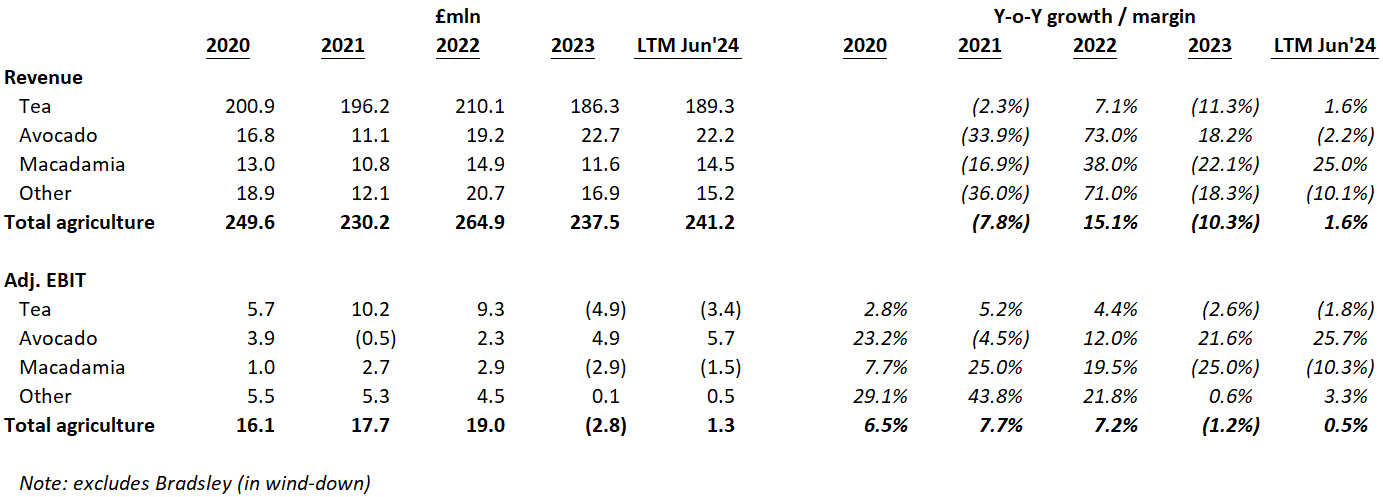
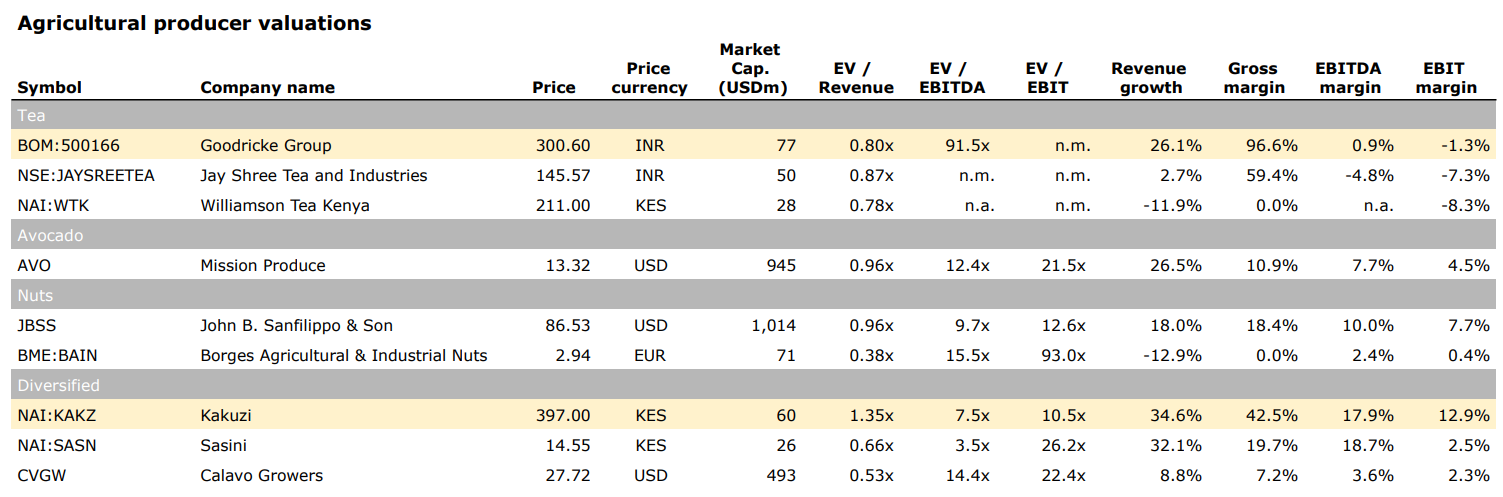
Tea: Despite coffee’s domination in the Americas and Continental Europe, global tea consumption has been steadily growing at ~3.5% p.a. over the last decade1. However, tea leaf prices do not always benefit from this trend as the market periodically finds itself in oversupply conditions (such as currently, in part due to large unsold quantities of East African tea). Moreover, producer profits are also being squeezed by labour cost inflation, while climate changes are affecting yields and tea quality. Nevertheless, the market normally re-adjusts in time, leading to recovery in prices and margins. In fact, despite the current depressed state of this segment, the market does attribute some value to tea estates (see comps below). Helpfully, Camellia’s tea operations in India are conducted through Goodricke Group, which is listed in Bombay (GOODRICKE.BO). Camellia owns 74% of Goodricke and its stake is currently valued at ~£45mln at market price.
Avocado: This tropical fruit is currently popular with health-conscious consumers in the West, particularly in the US and in Europe, where demand has been growing at double-digit rates2. The import pull from the major consumer countries has supported prices at healthy levels recently, despite ample supply. However, lower prices could well materialise in the future as more producing regions in Latin America, Africa and Spain enter the industry. For the time being, though, avocado producer valuations are fairly strong (see comps below). The bulk of Camellia’s avocado business is part of Kakuzi, a Kenyan company listed in Nairobi (symbol KUKZ) which also cultivates macadamia, blueberries, tea, livestock and timber. CAM owns 50.7% of Kakuzi and its stake is currently valued at ~£24mln at market price.
Macadamia: These nuts originating in Australia serve as an ingredient in the food industry (e.g. for ice cream) and are sold in retail, while macadamia oil is used in cosmetics. The demand trends for macadamia are somewhat less straightforward: the nuts do have attractive health benefits, but are relatively more expensive and not very well known by consumers, while on the ingredient side, food producers view macadamia supply as unreliable. Nevertheless, some sources forecast a healthy demand growth of 3-5% p.a. in the next 5 years, albeit partly predicated on macadamia becoming more affordable3. Nut producer valuations vary considerably (see comps), and unfortunately there is no direct listed benchmark for Camellia’s operations in this segment.
Other: The rest of Camellia’s agricultural business is a collection of various products, such as blueberries, grapes, soya, rubber, timber and livestock, which have their own cycles and trends that sometimes offset each other. For the past couple of years, Camellia also had an apples and pears business in the UK through Bardsley, which it acquired in 2021 for ~£10mln. This investment, however, performed extremely poorly, ostensibly due to high input cost inflation, such that Camellia decided to wind it down by the end this year4.
Overall, it must be noted that the agricultural business is heavily weighted to the second half of the year, and despite signs of market improvement (e.g. higher tea pricing in India), the company is still guiding to a £7-9mln loss for the current financial year.
Non-core assets
Camellia’s non-agricultural holdings include an engineering company, a stake in an insurance company, equities, real estate and collectables, each described below.
BF&M: Camellia owns a 36.9% stake in BF&M, a major domestic insurance company in Bermuda (listed locally under BFM.BH). Last year, CAM decided to sell its stake, and apparently was in such a rush that it agreed a deal with Argus (listed in Bermuda under AGH.BH), BF&M’s primary competitor in the island. The sale was agreed at US$100mln, a 34% premium to the BF&M’s share price. BF&M, for its part, took offence and put in a poison pill in order to give it time to consider options. In a few months, however, it found a deal of its own, which would give it a path to getting an indirect 30% ownership in Argus, and lifted the poison pill. Finally, in June this year, BF&M and Argus agreed to fully merge, which would happen after the buyout of Camellia’s stake. The merger is subject to regulatory approval and is expected to close by the year end. There are some concerns, however, about the competition impact of the merger of two dominant domestic insurers, especially in the health insurance segment. Nevertheless, Camellia’s non-controlling stake should be ultimately realisable, even if CAM has to search for another buyer.
Listed investments: The investment portfolio includes primarily listed equities (mostly in developed markets), as well as some money market investments, which were valued at £36mln in total as at Jun-24.
Real estate: The group owns a number of properties not used for principal activities in the UK and other countries, valued at ~£37mln (adjusted for disposals in H1’24), based on the last valuation as at Dec-23. The largest of the properties is the company’s impressive former headquarters Linton Park Estate, which was placed on the market at £32m, however is proving hard to sell for the time being.
Engineering: Camellia owns AJT Engineering, a Scotland-based company that provides threading, machining, welding and fabrication services, with 2023 revenue of £16mln. The business was loss-making for a number of years and only recently achieved a (marginal) profit as an under-performing division that provided contract heat treatment services was shut down.
Bangladeshi associates: Until very recently, Camellia owned 38% of United Finance and 37% of United Insurance, a leasing and an insurance companies, respectively, both listed in Dhaka. The stakes were sold last month for a total of ~£8mln.
Heritage assets: Finally, Camellia owns a collection of fine art, documents, manuscripts and stamps, which was valued at £7.5mln on its balance sheet as at Jun-24 (at cost). The company has been gradually putting these items out on the market and achieving proceeds of ~2x the book value recently.
Sum-of-the-parts and considerations
Taking all of the above together, we can estimate the SOTP value for Camellia as follows:
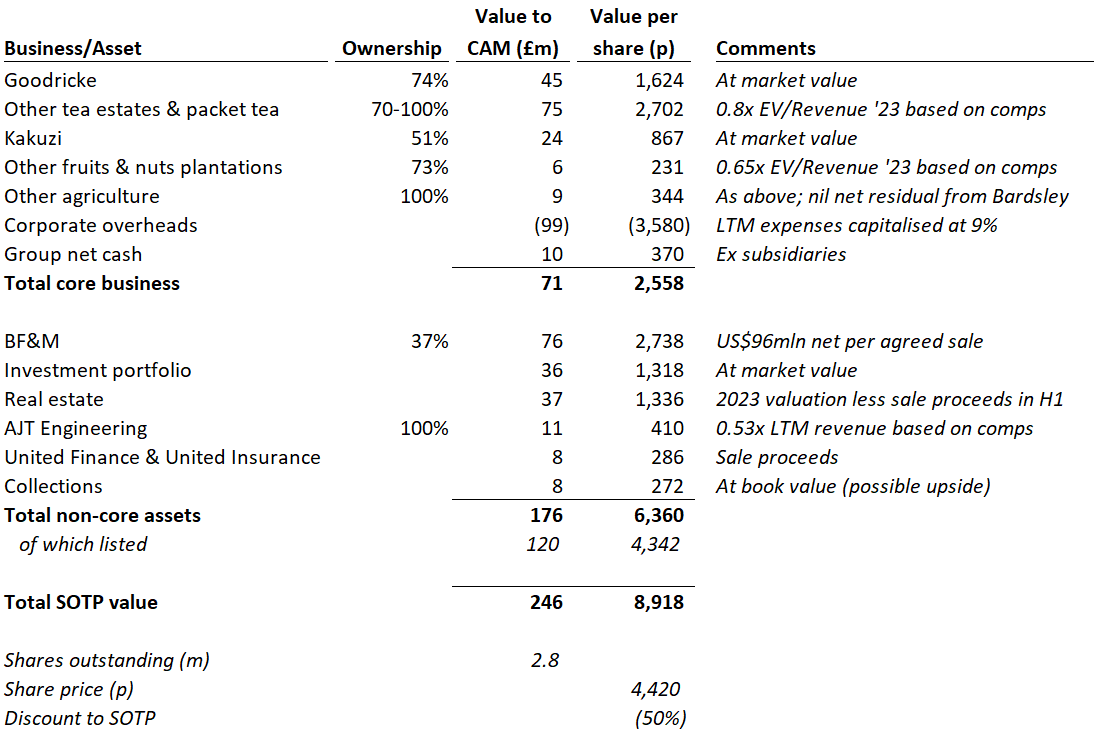
There are a few considerations related to the above discount that should be noted:
The discount will likely persist if the performance of the agricultural business does not improve, major asset disposals do not close and/or there is no meaningful return of capital;
CAM is controlled by The Camellia Foundation, a charitable trust that ultimately owns 51.7% of the share capital. The Foundation officially does not get involved in the day-to-day running of the business, but this ownership structure can make public shareholders hostages of the incumbent management and deter activism;
Management may continue efforts to diversify the business, which recently have been disastrous (e.g. Bardsley leading to £20mln+ losses);
In 2019-20, Camellia and Kakuzi were subject to allegations of systemic human rights abuses in East Africa, which resulted in £16mln in legal costs and settlements. Further scandals like this may be similarly costly;
There were a further £9mln provisions booked as at Jun-24 for ongoing wage and bonus negotiations in India and Bangladesh, which may have to be utilised in the current year;
Given the complicated structure of the group and shifting regulations, there could be some tax leakage upon asset sales (even though there were £32mln tax loss carry-forwards available as at Dec-23). In addition, there were ~£19mln assessments for past taxes in various countries disclosed as at Jun-24, however these were being contested by Camellia.
Important reminder: The above publication is for information only. No part of the analysis and none of the mentions in this post are intended nor should be construed as investment recommendations or offers to buy or sell any securities. Please do your own due diligence and manage your risk appropriately. You should also assume that the authors hold positions in the securities of the companies mentioned and may trade, enter or exit the positions at any price deemed suitable.
Source: FAO Major tropical fruits: Market review 2023
It is not entirely clear how it was possible to mismanage this business - which was said to be the UK's second-largest apple grower and existed for over 130 years - to the point of running it into the ground, while other growers did manage to survive during the same period.